






Segno — Making complexity legible
How to design a complex knowledge mapping system by making core actions clear, progressive, and outcome-oriented for users with different needs and levels of experience.
Discover the Case Studies
When product growth puts navigation under pressure
Discover the Case Study
Simplifying the Most Frequent Action
Discover the Case Study
Summary:
Results achieved:
- Greater clarity in identifying primary actions within the grid.
- Reduced operational friction in the most frequent contextual interactions.
- Clip creation that is more linear and predictable, with improved understanding of the action outcome.
- −22% time spent on key actions related to clip creation.
Team:
Giacomo Dalia, continuous collaboration with internal stakeholders and the development team.
My role:
Product Design Consultant — audit of the existing interface, identification of key usability and comprehension issues, design of new navigation flows and clip creation interactions, with a strong focus on outcome clarity and experience progression.
Introduction:
Segno is a knowledge mapping tool designed to structure, visualize, and interact with complex concepts and relationships in a structured and flexible way. Unlike traditional mind maps, Segno enables users to operate on multi-level knowledge networks, where concepts are not isolated elements but parts of dynamic systems that can be explored and reconfigured over time.
From an operational perspective, Segno allows ideas, hypotheses, and heterogeneous information to be transformed into a manageable visual environment: each concept can be created, connected, contextualized, and reused within custom semantic flows. Knowledge is not merely represented, but navigated, queried, and refined through semantic relationships and targeted interactions.
Context and origin
Segno originated within Relatronica, a design studio founded by professionals with a background at CERN and associated with the CERN Venture Connect (CVC) program. Relatronica operates at the intersection of speculative design, civic tech, and knowledge mapping, supporting researchers, institutions, and companies in understanding, discussing, and governing complex systems.
Originally, Segno was not conceived as a product, but as an internal tool supporting consulting activities. The need to manage large volumes of concepts, relationships, and design hypotheses led to the development of a flexible system shaped around the immediate needs of its creators.
The growth of the project was rapid and partially unplanned. It was the partners and organizations involved in consultancy work themselves who requested that Segno evolve into a tool usable beyond the internal context. This transition made it necessary to rethink the interface and usage flows, so that the system could adapt to different workflows and to users with diverse backgrounds, goals, and levels of experience.
The design challenge
The shift from an internal tool to a product exposed a trade-off typical of complex systems:
Segno was versatile and rich in potential, but strongly shaped by the habits of those who built it.
As features increased, two main critical issues became evident:
- Navigation and access to functionality: the organic growth of the system made it less clear how to perform certain actions and understand their role within the workflow.
- Cognitive load: much information was always visible, even when not relevant to the current phase of work, increasing perceived complexity.
The risk was that a tool designed to manage complexity would instead amplify it through its interface.
My role
I joined the project as a Product Design Consultant, contributing in a focused way to specific areas and initiatives of the product. My work concentrated on:
- Information architecture
- Interaction design
- Cognitive load reduction
- Clarification of primary flows
The goal was not to simplify the domain — Segno is designed to deal with complex systems — but to make core actions simple and legible, allowing complexity to surface only when it is genuinely needed.
Ambiti di intervento
The work focused on two key areas, documented in the corresponding case studies:
- Interface navigation redesignFocused on improving orientation within the system, clarifying user paths, and bringing attention back to the most relevant interactions at different moments of use.
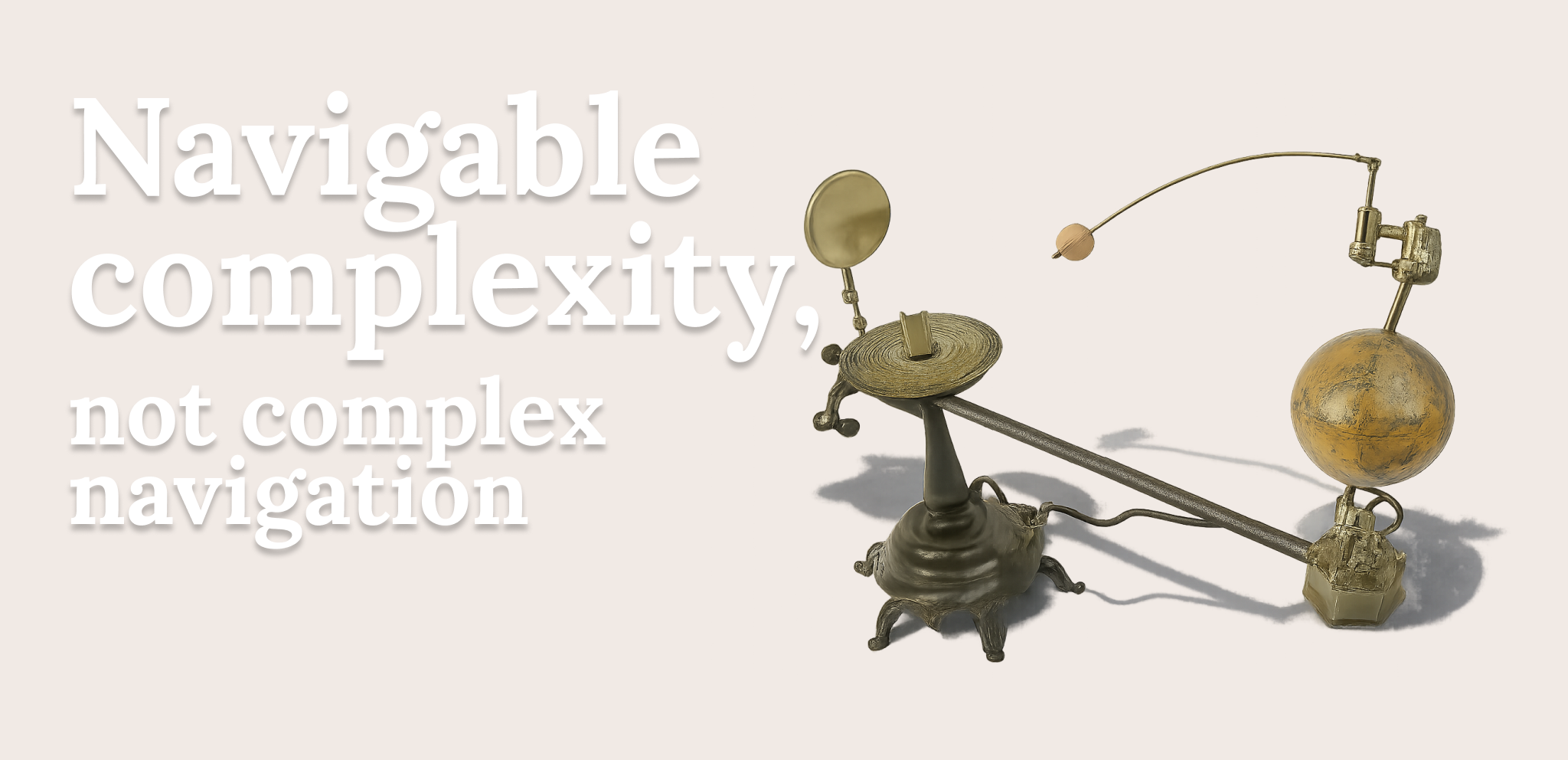
When product growth puts navigation under pressure
Completed in 2025.
A navigation redesign aimed at restoring clear hierarchies, making primary actions more recognizable, and supporting Segno’s functional growth without compromising user orientation.
Result:
Clearer navigation paths, more recognizable primary actions, and reduced uncertainty when switching between views.
Discover the Case Study
- Redesign of the clip creation modalClips represent the fundamental conceptual unit of Segno. A frequent and central action that, over time, had accumulated variants and options until it became as complex as the system it described. The redesign aimed to make clip creation straightforward, coherent, and scalable.
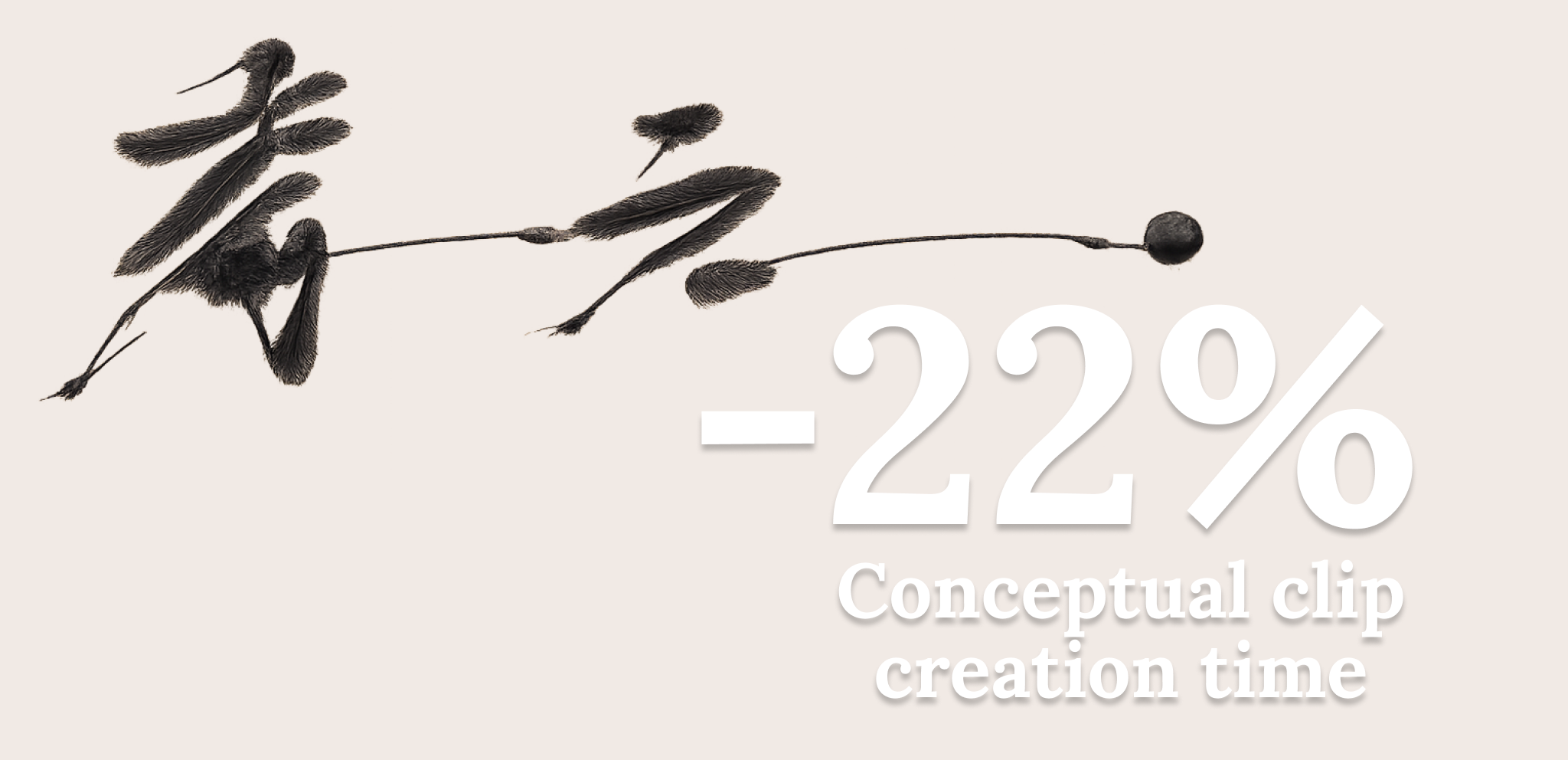
Simplifying the most frequent action
Completed in 2025.
A navigation redesign aimed at restoring clear hierarchies, making primary actions more recognizable, and supporting Segno’s functional growth without compromising user orientation.
Result:
−19% creation time for new users and −22% for experienced users, with improved clarity around the behavior and purpose of clips within the system.
Discover the Case Study
Results
The redesign of navigation and the clip creation modal produced coherent and complementary outcomes, supported by both qualitative and quantitative evidence:
- A reduction in cognitive load during frequent actions, observed through smoother flows and fewer clarification requests during testing
- Greater clarity of action outcomes, confirmed by user feedback indicating a better understanding of what would happen in the grid before completing an action
- A measurable improvement in operational efficiency, with task completion times reduced by −22% for new users and −27% for experienced users when using the new interactions
- Improved system legibility for first-time users, without penalizing advanced usage, as demonstrated by the fact that, after a short adaptation period, experienced users also benefited from the new model
Overall, these interventions helped make Segno more accessible and scalable, supporting its transition from an internal tool to a product usable by a broader audience.
The quantitative and qualitative results supporting these outcomes are discussed in detail in the individual case studies.
Current product state
At the time of writing, Segno is accessible to a restricted community of beta testers. A public-facing version is also available, with an educational and awareness-oriented purpose, designed to help individuals and companies understand the risks and implications of AI usage and data management.
https://segno.app/


Segno — Making complexity legible
How to design a complex knowledge mapping system by making core actions clear, progressive, and outcome-oriented for users with different needs and levels of experience.
Discover the Case Studies
When product growth puts navigation under pressure
Discover the Case Study
Simplifying the Most Frequent Action
Discover the Case Study
Summary:
Results achieved:
- Greater clarity in identifying primary actions within the grid.
- Reduced operational friction in the most frequent contextual interactions.
- Clip creation that is more linear and predictable, with improved understanding of the action outcome.
- −22% time spent on key actions related to clip creation.
Team:
Giacomo Dalia, continuous collaboration with internal stakeholders and the development team.
My role:
Product Design Consultant — audit of the existing interface, identification of key usability and comprehension issues, design of new navigation flows and clip creation interactions, with a strong focus on outcome clarity and experience progression.
Introduction:
Segno is a knowledge mapping tool designed to structure, visualize, and interact with complex concepts and relationships in a structured and flexible way. Unlike traditional mind maps, Segno enables users to operate on multi-level knowledge networks, where concepts are not isolated elements but parts of dynamic systems that can be explored and reconfigured over time.
From an operational perspective, Segno allows ideas, hypotheses, and heterogeneous information to be transformed into a manageable visual environment: each concept can be created, connected, contextualized, and reused within custom semantic flows. Knowledge is not merely represented, but navigated, queried, and refined through semantic relationships and targeted interactions.
Context and origin
Segno originated within Relatronica, a design studio founded by professionals with a background at CERN and associated with the CERN Venture Connect (CVC) program. Relatronica operates at the intersection of speculative design, civic tech, and knowledge mapping, supporting researchers, institutions, and companies in understanding, discussing, and governing complex systems.
Originally, Segno was not conceived as a product, but as an internal tool supporting consulting activities. The need to manage large volumes of concepts, relationships, and design hypotheses led to the development of a flexible system shaped around the immediate needs of its creators.
The growth of the project was rapid and partially unplanned. It was the partners and organizations involved in consultancy work themselves who requested that Segno evolve into a tool usable beyond the internal context. This transition made it necessary to rethink the interface and usage flows, so that the system could adapt to different workflows and to users with diverse backgrounds, goals, and levels of experience.
The design challenge
The shift from an internal tool to a product exposed a trade-off typical of complex systems:
Segno was versatile and rich in potential, but strongly shaped by the habits of those who built it.
As features increased, two main critical issues became evident:
- Navigation and access to functionality: the organic growth of the system made it less clear how to perform certain actions and understand their role within the workflow.
- Cognitive load: much information was always visible, even when not relevant to the current phase of work, increasing perceived complexity.
The risk was that a tool designed to manage complexity would instead amplify it through its interface.
My role
I joined the project as a Product Design Consultant, contributing in a focused way to specific areas and initiatives of the product. My work concentrated on:
- Information architecture
- Interaction design
- Cognitive load reduction
- Clarification of primary flows
The goal was not to simplify the domain — Segno is designed to deal with complex systems — but to make core actions simple and legible, allowing complexity to surface only when it is genuinely needed.
Ambiti di intervento
The work focused on two key areas, documented in the corresponding case studies:
- Interface navigation redesignFocused on improving orientation within the system, clarifying user paths, and bringing attention back to the most relevant interactions at different moments of use.
When product growth puts navigation under pressure
Completed in 2025.
A navigation redesign aimed at restoring clear hierarchies, making primary actions more recognizable, and supporting Segno’s functional growth without compromising user orientation.
Result:
Clearer navigation paths, more recognizable primary actions, and reduced uncertainty when switching between views.
- Redesign of the clip creation modalClips represent the fundamental conceptual unit of Segno. A frequent and central action that, over time, had accumulated variants and options until it became as complex as the system it described. The redesign aimed to make clip creation straightforward, coherent, and scalable.
Simplifying the most frequent action
Completed in 2025.
Redesign of the clip creation modal — the conceptual building blocks of Segno — to make clip creation faster and their systemic role within the product easier to understand.
Result:
−19% creation time for new users and −22% for experienced users, with improved clarity around the behavior and purpose of clips within the system.
Results
The redesign of navigation and the clip creation modal produced coherent and complementary outcomes, supported by both qualitative and quantitative evidence:
- A reduction in cognitive load during frequent actions, observed through smoother flows and fewer clarification requests during testing
- Greater clarity of action outcomes, confirmed by user feedback indicating a better understanding of what would happen in the grid before completing an action
- A measurable improvement in operational efficiency, with task completion times reduced by −22% for new users and −27% for experienced users when using the new interactions
- Improved system legibility for first-time users, without penalizing advanced usage, as demonstrated by the fact that, after a short adaptation period, experienced users also benefited from the new model
Overall, these interventions helped make Segno more accessible and scalable, supporting its transition from an internal tool to a product usable by a broader audience.
The quantitative and qualitative results supporting these outcomes are discussed in detail in the individual case studies.
Current product state
At the time of writing, Segno is accessible to a restricted community of beta testers. A public-facing version is also available, with an educational and awareness-oriented purpose, designed to help individuals and companies understand the risks and implications of AI usage and data management.
https://segno.app/Segno — Making complexity legible
How to design a complex knowledge mapping system by making core actions clear, progressive, and outcome-oriented for users with different needs and levels of experience.
Discover the Case Studies
When product growth puts navigation under pressure
Discover the Case Study
Simplifying the Most Frequent Action
Discover the Case Study
Summary:
Results achieved:
- Greater clarity in identifying primary actions within the grid.
- Reduced operational friction in the most frequent contextual interactions.
- Clip creation that is more linear and predictable, with improved understanding of the action outcome.
- −22% time spent on key actions related to clip creation.
Team:
Giacomo Dalia, continuous collaboration with internal stakeholders and the development team.
My role:
Product Design Consultant — audit of the existing interface, identification of key usability and comprehension issues, design of new navigation flows and clip creation interactions, with a strong focus on outcome clarity and experience progression.
Introduction:
Segno is a knowledge mapping tool designed to structure, visualize, and interact with complex concepts and relationships in a structured and flexible way. Unlike traditional mind maps, Segno enables users to operate on multi-level knowledge networks, where concepts are not isolated elements but parts of dynamic systems that can be explored and reconfigured over time.
From an operational perspective, Segno allows ideas, hypotheses, and heterogeneous information to be transformed into a manageable visual environment: each concept can be created, connected, contextualized, and reused within custom semantic flows. Knowledge is not merely represented, but navigated, queried, and refined through semantic relationships and targeted interactions.
Context and origin
Segno originated within Relatronica, a design studio founded by professionals with a background at CERN and associated with the CERN Venture Connect (CVC) program. Relatronica operates at the intersection of speculative design, civic tech, and knowledge mapping, supporting researchers, institutions, and companies in understanding, discussing, and governing complex systems.
Originally, Segno was not conceived as a product, but as an internal tool supporting consulting activities. The need to manage large volumes of concepts, relationships, and design hypotheses led to the development of a flexible system shaped around the immediate needs of its creators.
The growth of the project was rapid and partially unplanned. It was the partners and organizations involved in consultancy work themselves who requested that Segno evolve into a tool usable beyond the internal context. This transition made it necessary to rethink the interface and usage flows, so that the system could adapt to different workflows and to users with diverse backgrounds, goals, and levels of experience.
The design challenge
The shift from an internal tool to a product exposed a trade-off typical of complex systems:
Segno was versatile and rich in potential, but strongly shaped by the habits of those who built it.
As features increased, two main critical issues became evident:
- Navigation and access to functionality: the organic growth of the system made it less clear how to perform certain actions and understand their role within the workflow.
- Cognitive load: much information was always visible, even when not relevant to the current phase of work, increasing perceived complexity.
The risk was that a tool designed to manage complexity would instead amplify it through its interface.
My role
I joined the project as a Product Design Consultant, contributing in a focused way to specific areas and initiatives of the product. My work concentrated on:
- Information architecture
- Interaction design
- Cognitive load reduction
- Clarification of primary flows
The goal was not to simplify the domain — Segno is designed to deal with complex systems — but to make core actions simple and legible, allowing complexity to surface only when it is genuinely needed.
Ambiti di intervento
The work focused on two key areas, documented in the corresponding case studies:
- Interface navigation redesignFocused on improving orientation within the system, clarifying user paths, and bringing attention back to the most relevant interactions at different moments of use.
When product growth puts navigation under pressure
Completed in 2025.
A navigation redesign aimed at restoring clear hierarchies, making primary actions more recognizable, and supporting Segno’s functional growth without compromising user orientation.
Result:
Clearer navigation paths, more recognizable primary actions, and reduced uncertainty when switching between views.
- Redesign of the clip creation modalClips represent the fundamental conceptual unit of Segno. A frequent and central action that, over time, had accumulated variants and options until it became as complex as the system it described. The redesign aimed to make clip creation straightforward, coherent, and scalable.
Simplifying the most frequent action
Completed in 2025.
Redesign of the clip creation modal — the conceptual building blocks of Segno — to make clip creation faster and their systemic role within the product easier to understand.
Result:
−19% creation time for new users and −22% for experienced users, with improved clarity around the behavior and purpose of clips within the system.
Results
The redesign of navigation and the clip creation modal produced coherent and complementary outcomes, supported by both qualitative and quantitative evidence:
- A reduction in cognitive load during frequent actions, observed through smoother flows and fewer clarification requests during testing
- Greater clarity of action outcomes, confirmed by user feedback indicating a better understanding of what would happen in the grid before completing an action
- A measurable improvement in operational efficiency, with task completion times reduced by −22% for new users and −27% for experienced users when using the new interactions
- Improved system legibility for first-time users, without penalizing advanced usage, as demonstrated by the fact that, after a short adaptation period, experienced users also benefited from the new model
Overall, these interventions helped make Segno more accessible and scalable, supporting its transition from an internal tool to a product usable by a broader audience.
The quantitative and qualitative results supporting these outcomes are discussed in detail in the individual case studies.
Current product state
At the time of writing, Segno is accessible to a restricted community of beta testers. A public-facing version is also available, with an educational and awareness-oriented purpose, designed to help individuals and companies understand the risks and implications of AI usage and data management.
https://segno.app/